


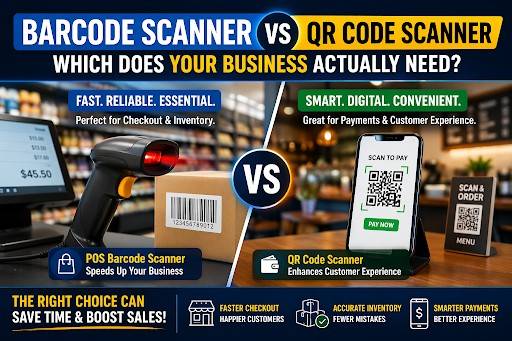
POS Barcode Scanner vs QR Code Scanner: Which Does Your Business Actually Need?
Contactless payment may be new, but it is definitely here to stay!
Why? Because it's quick, efficient, and comfortable for on-the-go customers in modern-day civilization. However, due to a highly saturated market, choosing the right scanning technology has become increasingly difficult.
In fact, QR codes have many other uses in addition to payments:
- Information Sharing
- Food Menus
- Digital Systems
Many businesses are now asking: Do we still need traditional POS Barcode Scanners, or should we switch to QR-based scanning systems?
If you, too, have found yourself in this predicament, this guide will definitely ease your burden. We have broken down everything in simple, practical terms so you can decide what actually fits your business, not just what sounds modern.
Get Started With Us
Fill in your details and we'll get back to you shortly.
The Basics of Barcode and QR Code Scanning
Before we start comparing the options, we need to be aware of their feature and usage. So, let's discuss that first.
Barcode Scanners (1D)
Barcode scanners, the OG scanner. They read traditional black-and-white linear codes (1D). You can easily find these types of scanners being used in:
- Retail
- Supermarkets
- Warehouses
- POS systems
In our discussion, we are discussing a specific barcode scanner for POS system setups, which is typically used for:
- Product pricing lookup
- Inventory tracking
- Billing at checkout counters
QR Code Scanners (2D)
On the other hand, QR code scanners. These scanners work differently from 1D barcode scanners. They read two-dimensional codes and are known for the high data storage they offer.
- Online payments (via phones)
- Digital menus (normally seen in restaurants, hotels, bistros, etc.)
- Website links and authentication systems
Unlike barcodes, QR codes offer greater accessibility, as they can be scanned with smartphones or dedicated devices.
Main Differences Between Barcode and QR Code Scanner
The difference between a barcode and a QR code scanner comes down to three main things: data capacity, speed, and use case.
Here, you must note the following aspects:
- Barcodes store limited product information
- QR codes store large amounts of data (URLs, payment info, text, etc.)
- Barcode scanners are optimized for POS and inventory systems
- QR scanners are optimized for customer interaction and digital workflows
In short, barcode scanners are operational tools, while QR scanners are experience-driven tools. So, choose wisely as per your daily requirements.
POS Barcode Scanner in Real Business Environments
A POS barcode scanner is still the backbone of retail and inventory-heavy businesses. Whether you're running a supermarket or a clothing store, all you need is a good small business POS and a reliable scanner, and you can get:
- Fast checkout processing
- Reduced human error in billing
- Real-time inventory updates
- Seamless POS integration
Most modern POS systems are built around barcode scanning because it remains the fastest and most reliable way to manage product-level data.
Even with digital transformation, physical retail still relies heavily on barcode systems for their accuracy and speed.
Barcode Scanner for Retail Store vs QR Systems
A barcode scanner for retail store operations is designed for high-speed checkout environments. Retail staff can scan multiple items in seconds, making it ideal for peak-hour traffic.
QR systems, on the other hand, are often used in:
- Self-order kiosks
- Loyalty programs
- Mobile-based promotions
Retailers often combine both systems instead of replacing one with the other.
QR Code Scanner for Payments and Customer Experience
One of the biggest reasons QR adoption has increased is the rise of digital payments. A QR code scanner for payments allows customers to:
- Pay via mobile wallets
- Scan and complete transactions instantly
- Avoid physical cash handling
This is especially popular in cafes, small shops, and delivery-based businesses. It improves convenience but doesn't replace backend inventory systems.
POS Barcode Scanner vs QR Scanner: Which Is Better?
There's no universal winner here. It depends on your business model.
- Retail-heavy businesses → Barcode scanners win
- Digital-first or service businesses → QR systems win
- Hybrid businesses → Use both together
The POS barcode scanner vs QR scanner debate isn't about replacement; it's about integration.
1D vs 2D Barcode Scanner Comparison
A major technical difference lies in scanning capability.
- 1D scanners → read traditional barcodes only
- 2D scanners → read both barcodes and QR codes
But statistically, most modern best scanners for point-of-sale system setups are built around 2D scanners because they offer flexibility without locking you into one format.
If you're planning long-term, 2D scanners are more future-proof and efficient in the long run.
Handheld Barcode Scanner vs Mobile QR Scanner
In a discussion of handheld barcode scanner vs mobile QR scanner, we can all see a stark difference in features and usability:
Handheld Barcode Scanner
- They offer fast processing and are perfect for retail environments
- Works very well with various types of POS systems
- More durable for businesses with high-volume processing needs
Mobile QR Scanner
- It is mostly used via a smartphone or tablet
- Not bound to one dedicated hardware
- Better for small or mobile businesses
While mobile QR scanners seem to have the upper hand, we must not forget that they tend to slow down under heavy transaction loads.
Barcode Reader for Inventory Management
A barcode reader for inventory management is an important player in warehouses and large retail stores. It helps businesses accomplish most of the core tasks effectively. It offers assistance via:
- Tracking stock levels
- Reducing shrinkage
- Lessening the chances of theft
- Automating reordering systems
- Improving supply chain visibility
QR systems are less common for heavy backend inventory control because they can introduce scanning inefficiencies in bulk operations compared with dedicated barcode workflows.
QR Code Ordering System for Cafes and Restaurants
A QR code ordering system has become very popular for cafes. Customers scan a QR code, browse the menu, and place orders directly via these smart scanners.
They are highly beneficial for hospitality businesses as the benefits include:
- Reduced staff workload
- Contactless ordering experience
- Faster table turnover
- Easy menu updates
However, many cafes still rely on barcode systems behind the counter for stock and billing accuracy.
Barcode vs QR Code Use Cases in Business
Different industries use scanning systems differently:
- Retail businesses use barcode systems
- Restaurant businesses use QR menus and a barcode POS hybrid for faster processing
- Warehouse businesses use barcode inventory systems for streamlining logistics
- E-commerce businesses use barcode tracking and QR returns to simplify order management
This shows that the use cases for barcodes vs. QR codes in business are complementary, not competitive.
Barcode Scanner Compatibility with POS Systems
One key factor businesses often ignore is integration. They tend to get a good high-tech scanner but overlook the integration needs of their POS system. Not all barcode scanners are compatible with all POS systems.
So, always make sure that a POS barcode scanner is compatible with your POS software.
Before buying, check:
- Plug-and-play support (USB/Bluetooth)
- POS software compatibility
- Scan speed and durability
- Wired vs wireless options
QR Code vs Barcode Pros and Cons
Barcode Pros
- Faster scanning for bulk items
- Highly accurate
- Low cost
- Industry standard in retail
Barcode Cons
- Limited data storage
- Requires line-of-sight scanning
QR Code Pros
- Stores large data
- Mobile-friendly
- Great for customer engagement
QR Code Cons
- Slower in high-volume checkout
- Dependent on smartphones or cameras
Cost of Barcode Scanner & QR Code System
The cost of a barcode scanner vs. a QR code system varies:
- Barcode scanners: $30–$200 (hardware-based)
- QR systems: often low-cost or software-based
However, QR systems may require platform subscriptions. In contrast, the barcode scanners are mostly one-time hardware purchases.
Barcode Scanner for Warehouse Management
A barcode scanner for warehouse management is important for logistics-heavy businesses. It helps:
- Track shipments
- Manage storage locations
- Improve order accuracy
- Reduce operational delays
This is where barcode systems clearly outperform QR-based setups due to speed and structure.
Best Scanning Solution for Retail Business
If you're looking for the best scanning solution for a retail business, the safest approach is:
- Use barcode scanners for POS and inventory
- Add QR systems for payments and customer interaction
- Upgrade to 2D scanners for flexibility
This hybrid model is what most modern retail businesses are shifting toward.
Conclusion
Both barcode and QR technologies have strong roles in modern business operations. A POS barcode scanner remains an important player for speed, accuracy, and inventory control.
On the other side, QR systems enhance customer experience and digital transactions.
Rather than choosing one over the other, most growing businesses benefit from combining both, depending on operational needs. Learn more about the role of good peripherals for businesses in our guide.
If your goal is efficiency at checkout and reliable inventory control, investing in a high-quality POS barcode scanner setup is still one of the most practical decisions you can make.
Looking to upgrade your checkout or inventory system? With Soireeinc, choose a scanning solution that matches your business workflow, not just trends. The right setup today can save hours of manual work tomorrow. Get in touch with our team.