


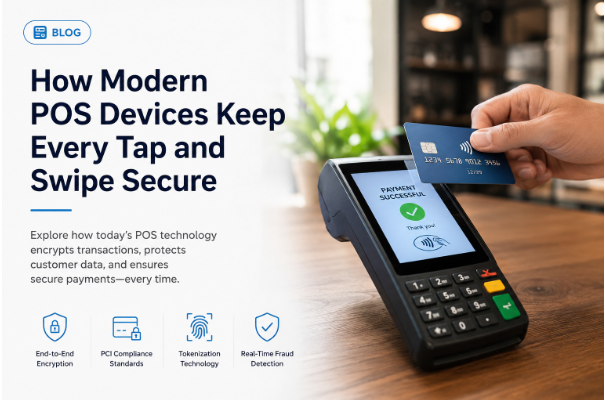
How Modern POS Devices Keep Every Tap and Swipe Secure
Here's something most merchants don't think about until it's too late: the terminal you're using right now might be the weakest link in your entire payment setup. Old hardware, outdated firmware, and no real certification behind it.
That's the gap theA77 Smart Mobile POS was built to close, not with a marketing pitch, but with an actual layered security design that works whether you're running a busy retail counter or handing a device to drivers who are out on the road all day.
I want to walk through what's actually happening inside this thing during a transaction, because once you understand that, the "why should I switch" question kind of answers itself.
What Makes the A77 Mobile POS Device Worth a Second Look
Most handheld terminals pick a lane. Either they're quick and a bit loose on compliance, or they're locked down tight and feel clunky to use.
Most handheld terminals pick a lane. Either they're quick and a bit loose on compliance, or they're locked down tight and feel clunky to use A77 Mobile POS device doesn't really pick a lane, which is unusual.
It runs Android. Small detail on paper, but it changes a lot in practice. You can load loyalty apps, inventory software, custom receipts, whatever your business needs, straight onto the device. No second gadget taped to the counter. And yet, the part of the device handling actual card data is sealed off from all of that. A buggy third-party app can crash all it wants. It physically can't touch the payment core.
That separation between "everyday apps" and "payment core" doesn't get talked about much, but it's a big part of why thePAX A77 mobile POS has built a loyal following among merchants who want one device, not three.
PCI PTS Certification: The Boring Part That Actually Matters
People skip straight to encryption when they talk about security. Fair enough, it's the flashier topic. But hardware security starts earlier than that, and this is where a lot of budget terminals quietly cut corners.
The A77 carries PCI PTS certified payment device status. That means the PCI Security Standards Counci actually tested it, not just for software weaknesses but for physical tampering too. In practice, the device notices if someone tries to pry it open. Cryptographic keys live in an isolated, protected module. Firmware updates won't install unless they're verified first.
Why does a certification label matter to you as a business owner? Because when something goes wrong, liability tends to follow the hardware. Use an uncertified device, and a breach happens, and that risk often lands on your business, not the manufacturer's. Certification shifts a real chunk of that exposure off your plate.
EMV and NFC, Not One or the Other
Customers pay however they feel that day. Chip one visit, tap the next. A terminal that can't keep up with both isn't really a modern terminal. The A77 handles EMV chip card payments and NFC contactless payments as two halves of the same system, not separate bolted-on features.
Every EMV chip transaction kicks out a one-time cryptographic code. Try to reuse it, and it's dead on arrival, which is exactly why cloned chip cards almost never work the way cloned magnetic stripe cards used to back in the day. That whole fraud playbook just doesn't translate anymore.
NFC works on roughly the same idea. Tap a card or a phone, the terminal and the card swap encrypted data over a short-range signal, backed again by a single-use cryptographic value. Neither method leaves a static card number sitting out in the open for anyone to grab. That's a big part of why the Android smart POS terminal experience stays fast for customers while being a genuine headache for anyone trying to intercept it.
What Happens in Those Two Seconds Between Tap and Approval
This is the part almost nobody thinks about. You tap, you wait a second or two, and "Approved" shows up. What actually happened in between?
The terminal reads the chip or the NFC signal and encrypts it almost instantly, before that data ever sits exposed in the device's memory. Then point-to-point encryption scrambles it further, using keys unique to that one session and that one terminal, not some generic key shared across a thousand devices. After that, the real card number gets swapped out for a token. Just a random reference number, worthless to anyone who somehow intercepts it. That tokenized, encrypted package heads off to the payment processor over a secure connection, and the bank fires back an approval or decline, usually within a second or two.
That's real-time transaction security in practice. The whole design rests on one blunt assumption: even if someone grabs the data mid-transit, it should be completely useless to them.
Encryption and Tokenization Get Confused a Lot
People use these two terms interchangeably, but they're not doing the same job.
Encrypted payment transactions protect data while it's on the move, from the terminal to the processor. Picture a sealed envelope that only the right person can open. Tokenized payment processing kicks in after the fact. Even if someone broke into a merchant's stored transaction records, all they'd find is a pile of tokens, meaningless strings with zero path back to a real card number.
Stack those two together, and you get secure cardholder data protection that isn't hanging on one single point of failure. One layer gets bypassed, somehow, the other one's still doing its job.
Mobility Changes the Whole Risk Picture
A countertop terminal lives in one spot, on one network, behind one set of locked doors. A mobile terminal doesn't get any of that. It travels with the delivery driver, the market vendor, and the field rep who's in five different locations before lunch.
That's precisely why mobile payment terminal security has to go further than just good encryption. The A77 backs it up with tamper sensors that shut down payment functions the moment someone forces the casing open, a secure boot process that checks the device hasn't been tampered with before it even finishes starting up, and remote tools that let an IT team lock or wipe a lost device the second it's reported missing.
Doesn't sound like much until the day a device actually goes missing. Then it's the only thing standing between "minor inconvenience" and "actual breach."
A Quick, Real Scenario
Picture a grocery delivery service handing drivers the A77 Smart Mobile POS. A driver taps a customer's card at the door. Within about two seconds, that chip data has been encrypted, tokenized, sent off, and approved, all without the raw card number ever sitting around in a readable form longer than a blink.
Now picture that driver's bag getting left on a bus. Or stolen outright. There's nothing usable on that device. No stored card numbers, no readable transaction logs. The entire model assumes the hardware itself might end up somewhere it shouldn't, and it's built so that scenario doesn't turn into a disaster for the business or the customer.
Certification Over Marketing Copy, Every Time
Worth being a little skeptical here. Ask who actually certified the device, what standards it passed, and how the process genuinely works, instead of just trusting whatever's printed on the box. What actually makes the PAX A77 mobile POS secure isn't one headline feature. It's the stack: certified hardware underneath, card data that changes every single transaction, encryption while it's moving, and tokenization once it's stored. That layered approach is what auditors and processors actually check for when they're assessing real risk, not reading a brochure someone wrote in marketing.
Final Thoughts
Picking a payment terminal is a security decision wearing a hardware-purchase costume. It touches your liability, your customers' trust, and how smoothly your operations actually run day to day. The A77 is a decent example of what a mobile terminal looks like when nobody cut corners along the way, from the first tap all the way through to final authorization.
So next time you're comparing terminals, skip the "how fast is it" question for a second. Ask what happens to the data in between. That's the question this device was actually built to answer.
Frequently Asked Questions
Yes. It carries PCI PTS certification, meaning it's been independently tested by the PCI Security Standards Council for both physical tamper resistance and protection of stored cryptographic keys.
It supports both EMV chip card payments and NFC contactless payments, so customers can tap or insert depending on what they prefer, without any drop in processing speed.
Most transactions are completed within one to two seconds, from the moment the card is read to the bank sending back an approval or decline.
Very little risk, by design. The device doesn't store raw card numbers, only encrypted and tokenized data, and IT teams can remotely lock or wipe a missing unit the moment it's reported.
Encryption protects card data while it's traveling from the terminal to the payment processor. Tokenization protects it afterward by replacing the real card number with a meaningless reference value that can't be reversed.
Get Started With Us
Fill in your details and we'll get back to you shortly.