


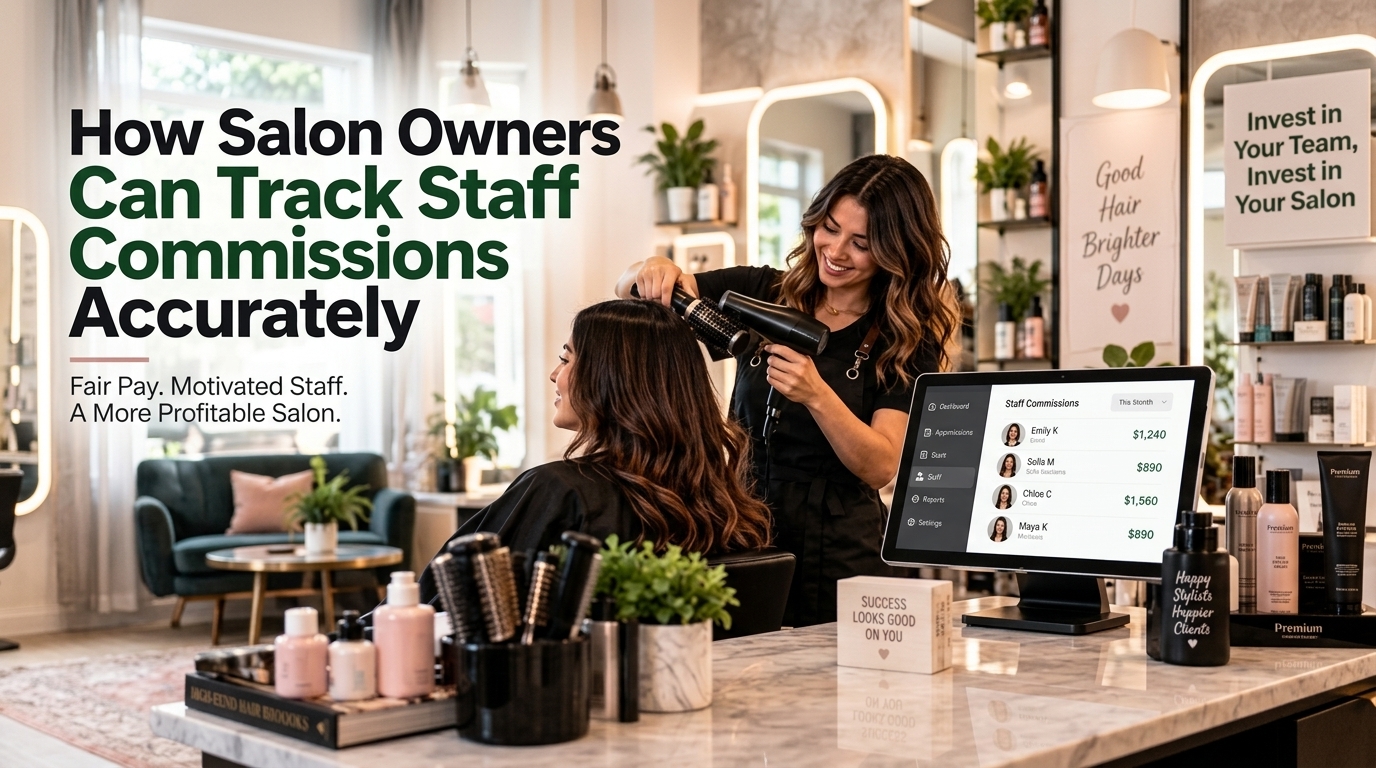
How Salon Owners Track Staff Commissions the Right Way
Most salon owners still track staff commissions on spreadsheets. It looks simple, but one wrong formula or one missed tip can suddenly turn payday into a problem. Running a spa or a hair salon means juggling multiple staff, different rates, and daily transactions. Getting commissions right is not just about paying on time. It keeps your best talent motivated and your books clean.
In this blog, we cover why manual tracking fails, how to build a structure your staff actually trusts, and how a salon and spa POS system takes the guesswork out of every pay cycle.
Get Started With Us
Fill in your details and we'll get back to you shortly.
The Real Cost of Tracking Salon Commissions Manually
Spreadsheets look simple. But the moment your team grows, they break down fast. Juggling multiple stylists, therapists, and front desk staff with different rates turns salon commission calculation into a daily headache. One copy-paste error is all it takes, and suddenly someone gets underpaid. Payday becomes a fight. When two staff members work on the same client, who gets the commission? Most spreadsheets have no answer for that.
Discounted services add even more confusion. If a client pays a reduced rate, does the stylist earn commission on the full price or the discounted one? Manual tracking leaves that question unanswered every single time. These are not rare edge cases. They happen every week in busy salons. And every unresolved calculation chips away at staff morale.
Which Salon Commission Model Actually Works for Your Team
Not every salon runs the same way. So not every commission model works the same way either. Picking the wrong one leads to underpaid staff, squeezed margins, and constant disputes. Here are the four main models and when each one makes sense.
Flat Rate Commission
Every stylist earns the same percentage on every service regardless of complexity or skill. It is the easiest model to set up and explain to your team. The calculation is straightforward when you clearly define the rate and eligible sales. But a flat rate does not reward experience. Your senior stylist handling advanced treatments earns the same as a junior doing basic services.
Tiered Commission
This model splits earnings into levels. Once a stylist reaches a defined sales target, a higher commission rate can apply according to your written policy. It sounds simple, but it changes how your team thinks. Stylists start upselling, rebooking clients, and pushing retail. All because a better month means better pay. Great for salons ready to scale.
Service-Based Commission
Different services earn different rates. A basic haircut might earn 35% while an advanced color treatment earns 50%. This model reflects the actual skill and time each demands. Your senior stylists feel valued, and your juniors have something to work toward. More complex to manage manually, but far fairer for your whole team.
Retail Commission
Most salons overlook this entirely. Your stylists recommend products to clients every single day. But without a separate commission on retail sales, that motivation disappears fast. A dedicated retail commission keeps your team actively suggesting the right products. It also adds a steady revenue stream you do not have to work hard for.
How to Build a Salon Commission Structure in Simple Steps
Your staff works hard every day. They deserve to know exactly how their commission is calculated every single time. Because when people trust the system, they stop counting and start performing.
Step 1: Calculate Your True Service Costs
Add Up Overhead
Start by listing every cost your salon carries. Rent, utilities, products, staff salaries, and marketing. Estimate each service's cost by accounting for the time, products, and share of overhead it uses. Without this number, any commission you set is just a guess.
Protect Your Margins
Once you know your costs, set a commission percentage that leaves your salon profitable. Set commission rates after reviewing service costs, employee pay, and the profit margin your salon needs. Go above that, and your margins shrink fast. As your salon grows, you can always reward top performers with higher rates.
Step 2: Choose Your Commission Framework
Straight Commission
This is the simplest setup. Your stylist earns a fixed percentage on every service they perform. No targets, no tiers, no complications. It works well when you are just starting out and want something easy to manage. But it does not push your team to grow. What they earn today is what they will earn six months from now.
Base Plus Commission
This model combines a fixed base salary with commission-based salon pay. Your stylist gets a guaranteed amount every month regardless of performance. Then they earn extra on every service they deliver. It removes financial stress for your team. And it keeps them motivated to perform without worrying about a slow week.
Tiered / Sliding Scale
Rates go up as performance goes up. Hit a target and unlock a better percentage for that month. It creates healthy competition within your team. Your top performers earn more, and your salon grows faster. Best for established salons ready to scale without micromanaging every single shift.
Step 3: Document and Automate
Put It in Writing
Every commission rule needs to be written before your first payout. Write down each model, percentage, and condition clearly. Share it with every staff member before they start. With everything in writing, there's no confusion and no arguments. Just clear terms everyone agreed to from day one.
Track Performance Transparently
Your staff should never have to guess what they earned. Share performance numbers regularly with every team member. When stylists see their own progress, they work harder to improve it. Transparency removes doubt and builds loyalty. A team that trusts the numbers stays longer and performs better.
Common Mistakes Salons Make When Managing Commissions
Salons lose trust and profit when they rely on manual math, vague agreements, and flawed splits to manage employee payouts.
- Paying the same commission rate on discounted services as full-price services.
- Tracking retail and service commissions together instead of separately.
- Calculating payouts at month-end instead of updating in real time.
- Never revisiting your commission model as your salon grows and costs change.
- Keeping commission rules verbal instead of putting them in writing.
How to Track Salon Commissions Without the Monthly Chaos
- Every service billed means every commission is updated instantly. No waiting, no manual entry at the end of the day.
- When two staff members work on the same client, the system splits the commission automatically based on your preset rules.
- Retail and service commissions stay in separate buckets, so every payout reflects exactly what each stylist earned.
- A POS system for salons calculates every payout in real time so month-end becomes a five-minute review, not a half-day headache.
- At pay cycle close, your reports are already clean and ready to hand straight to your accountant.
Conclusion
Commission tracking is not just a payroll task. It tells how your staff feels about working for you. Get it right, and they will stay. Get it wrong, and payday becomes the most dreaded day of the month. A clear structure, documented rules, and real-time tracking fix most problems before they start. Understanding how salon commissions work is the first step. Acting on it is what separates struggling salons from thriving ones. If you are ready to track staff commissions accurately, visit our website, Soiree Inc., to find a modern POS system built for salons and spas of every size.