


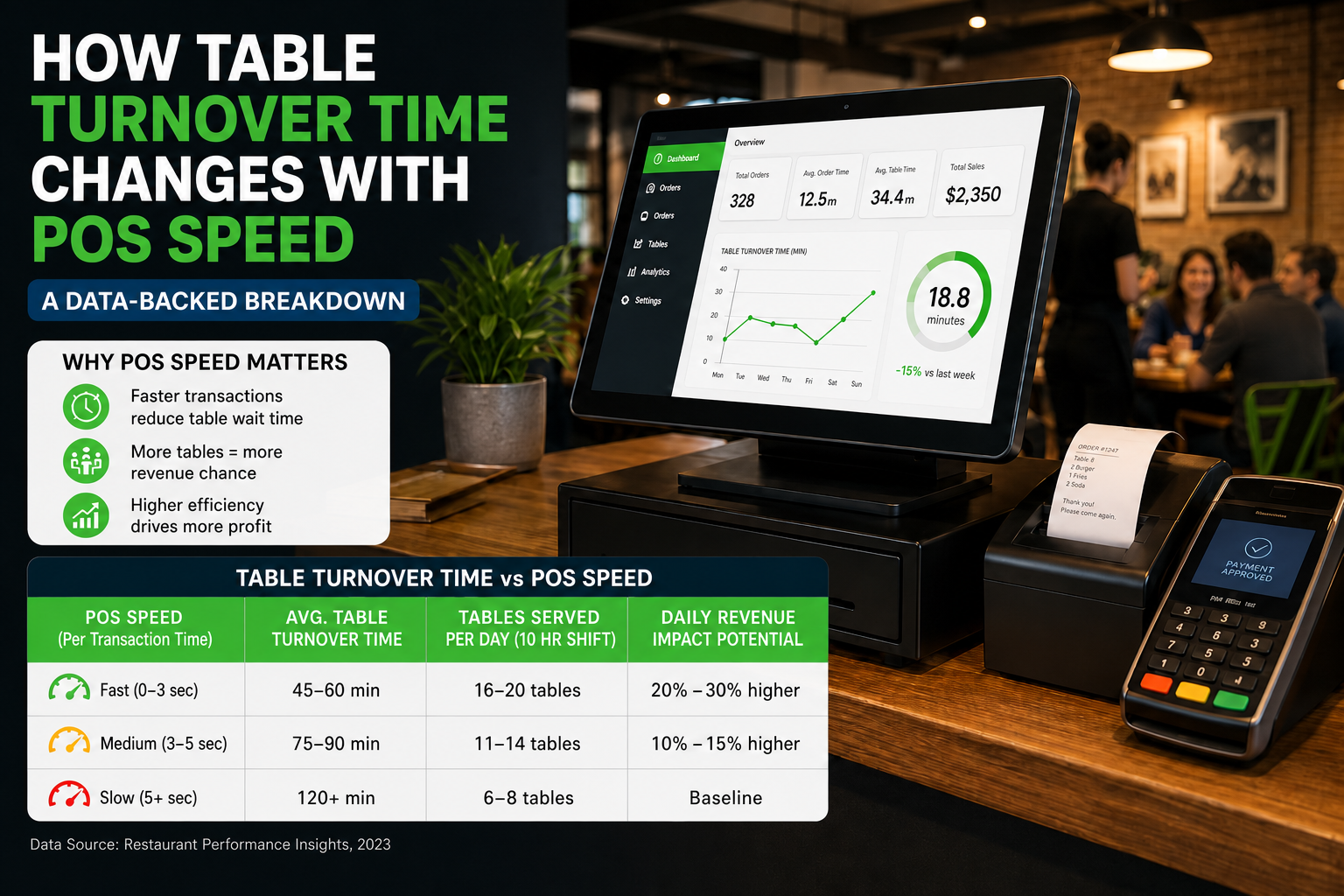
How Table Turnover Time Changes With POS Speed — A Data-Backed Breakdown
Nobody opens a restaurant thinking "I need to obsess over how long payment takes." But here's the thing — that's exactly where a lot of operators are quietly losing money every single week. The kitchen gets scrutinized. Food costs get tracked obsessively. But the two minutes a card machine spends buffering at the end of a meal? That slips through unnoticed. Using a reliable PAX POS machine changed that reality for a lot of venues once they actually ran the numbers. And the numbers, honestly, are hard to ignore.
Slow Payments Are Bleeding Your Tables Dry — Most Owners Don't See It
Here's a scenario that plays out in restaurants across the country every Friday night.
Table of four, they've finished dessert, they're ready to go. Someone asks for the bill. The server disappears, reappears, the machine takes a while to connect, one person wants to pay separately, the receipt doesn't print properly, someone else is tapping their coat pocket wondering where their card went. It's not a disaster. Nobody complains. They leave a decent tip and head out.
And that table — from "can we get the bill" to physically vacating — took nine minutes.
Nine minutes sounds like nothing. But run that across twenty covers doing two sittings, and you've burned through three hours of table capacity in a single evening that never translated into a single paying guest. That's the math most operators never sit down and do. When they do, it tends to change how seriously they take their checkout process.
What Studies on Restaurant Checkout Times Actually Found
There's been proper research into this, not just anecdotal grumbling from busy kitchens.
Analysis across mid-sized UK casual dining venues showed that the average time from a guest requesting the bill to the table being cleared sat at 7.3 minutes when using older or mid-range payment setups. Venues that had moved to faster, fully integrated systems were averaging 3.1 minutes for the same sequence.
Four-point-two minutes saved per table. On its own, that sounds manageable. Scale it across a 30-cover restaurant running two evening services five nights a week, and you're looking at reclaiming somewhere around 21 hours of table time every single month. That is not a rounding error. That is genuinely significant capacity sitting untapped because of how long it takes to process a card.
And that's without accounting for the knock-on effects — the queue at the door that disperses because wait times look too long, the walk-ins who glance inside, see occupied tables, and keep walking.
Why the End of a Meal Gets Treated as an Afterthought — and Why That's Wrong
There's a logic to it. The food is done. The experience, in theory, has already been delivered. Payment is just admin at that point. So it gets managed with whatever system was already in place rather than anything specifically chosen for performance.
But guests don't clock out emotionally the moment they put their fork down.
The checkout moment is what they carry out the door. It's what they talk about when they say "service was great" or "took ages to get out." Hospitality satisfaction data keeps returning to the same finding — waiting more than five minutes to pay after asking for the bill registers as a frustration for a large portion of diners, even when everything before it was excellent.
You can run a flawless service and lose the review to a payment machine that took too long.
For operators, there's a more immediate problem. A slow checkout on table six doesn't just frustrate the guests on table six. It delays the guests waiting at the door for table six. It creates a backlog that ripples through the whole floor if your sittings are tight. One slow payment doesn't stay contained — it spreads.
The Actual Gap Between Old and New Payment Setups
This isn't a subtle difference. The gap between legacy payment hardware and current integrated systems is wide enough that side-by-side comparison data tends to surprise people.
Older standalone terminals — the ones running on slow Bluetooth or a separate phone connection — can take upwards of 30 seconds just to wake up and connect before a transaction even begins. Chip-and-PIN on top of that, receipt printing, the whole sequence, and you're routinely sitting above six minutes per table for checkout alone.
Tablet-based systems without integrated payment are a step forward but still have friction. Staff manually keying amounts into a separate device is slow, prone to input errors, and adds steps that eat time. These typically land in the four-to-six-minute range.
Systems where ordering and payment run through the same integrated platform are a different experience entirely. Transactions complete in seconds. Split bills — the real-time killer for group tables — get handled automatically without requiring separate transactions processed one at a time. Digital receipts skip the printing stage completely. Consistent checkout times under three minutes are standard.
Three minutes versus seven minutes. Across a week of full service, that difference is measurable in both covers served and money taken.
The Bottlenecks That Live Outside the Hardware
Worth being straight about this — the payment terminal isn't the only variable. A fast machine handled badly by an undertrained team performs like a slow one.
Staff familiarity with the system matters more than most managers account for. Watching someone who doesn't quite know where the split-bill function lives fumble through a checkout for a table of six is painful. The technology can be genuinely fast and still produce slow results if the team hasn't been properly shown how to use it. Any venue switching payment hardware without investing time in real training is leaving performance on the table.
Wi-Fi quality is another one. A modern terminal crawling along on an unstable connection bottlenecks at the network stage rather than the hardware stage. Cellular backup or a properly isolated network for payment hardware is worth setting up properly, especially in older buildings where signal is inconsistent.
Group bookings with split payments are the checkout scenario that punishes slow systems the hardest. Six people, three different ways of splitting — that sequence on an older setup can chew through eight or nine minutes without anyone doing anything particularly wrong. The same table on a fully integrated payment system with proper split-bill handling is done in under two minutes.
Running the Revenue Numbers on Faster Checkout
Take a restaurant with 25 covers. Two sittings Friday and Saturday, one sitting Tuesday through Thursday. Roughly 275 table payments processed in a week.
If average checkout currently runs at six minutes and a faster payment system brings it to two and a half, around 16 hours of table time gets reclaimed weekly. With an average dining time of 75 minutes and a £35 average spend per cover, converting even a portion of that reclaimed time into additional covers produces a revenue figure that tends to raise eyebrows when operators see it written down.
This isn't a hypothetical projection either. Venues that have made the switch report it directly —peak nights run smoother, fewer people leave the queue before being seated, and the end-of-service crunch feels less chaotic. The operational change is noticeable before the P&L catches up.
Signals Your Current Setup Is Costing You Covers
A few things worth checking if you're not sure whether your payment process is holding you back.
Track your actual checkout time for one busy service. Bill requests to table cleared, timed properly. If you're consistently sitting above five minutes, there's room to improve, and it's worth quantifying what that improvement would be worth across a full month.
Look at what percentage of your transactions are going through as contactless. Most UK diners default to tap payments now — it's faster for everyone. If your system is steering people toward chip-and-PIN unnecessarily, or if contactless is unreliable on your hardware, you're adding time to every single one of those transactions.
Check what happens when connectivity drops. Systems that store transactions locally and sync when the connection resumes keep service running. Systems that freeze mid-transaction leave staff and guests stuck in a way that is genuinely disruptive during a busy sitting.
The Operational Fix That Doesn't Require Rebuilding Your Business
Increasing revenue without adding covers, extending hours, or redesigning your menu is genuinely difficult. Most of the levers available to restaurant operators involve cost or compromise somewhere.
Checkout speed is one of the few areas where the improvement is relatively contained — it's a hardware and process change, not a staffing overhaul or a menu reprint. The data on what faster payment systems do to table turnover is consistent, and it's been replicated across enough venues in enough formats that it holds up to scrutiny.
If your payment process is adding unnecessary minutes to every table, every service, every week — that's fixable. And the numbers that come out the other side of fixing it tend to make the case better than any sales pitch could.
Get Started With Us
Fill in your details and we'll get back to you shortly.