


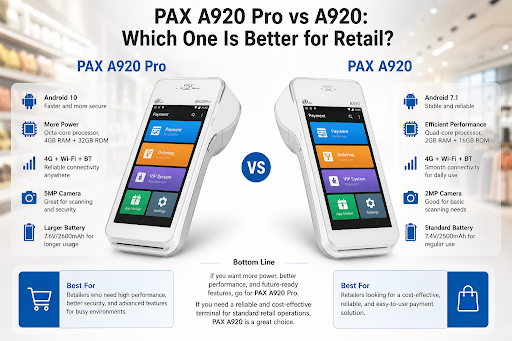
PAX A920 Pro vs A920: Which One Is Better for Retail?
A retailer I spoke with last month put it pretty simply: "I don't care about specs, I just want my till to not freeze on a Saturday." That's really the whole debate around the A920 Pro Smart Mobile POS in one sentence. Everyone wants to know if the Pro version is worth paying more for, or if the regular one will do just fine. There's no one-size answer here, so let's actually break it down instead of just listing numbers off a spec sheet.
Get Started With Us
Fill in your details and we'll get back to you shortly.
Why Everyone's Suddenly Comparing These Two
A few years back, nobody thought twice about their card machine. It just had to work. Now? Customers expect a tap-and-go payment to register in under a second, and if it doesn't, they notice. Cashiers notice too, especially when there's a line forming behind someone whose payment is stuck "processing."
That's the real reason the A920 Smart POS device and its newer Pro sibling keep popping up in the same conversation. Both come from PAX. Both run Android. At a glance, they almost look like the same machine with a different sticker. But PAX didn't make changes for no reason, and once you know what those changes were actually solving, it gets a lot easier to pick a side.
What You Get With the Standard A920
The regular A920 isn't new anymore, but that's not automatically a bad thing — it's had years to get tested in real shops, real queues, real chaotic Friday evenings. Roughly speaking, here's what's inside it:
- Quad-core processor, fine for normal day-to-day transaction speed
- 5-inch screen with Gorilla Glass so it can survive being dropped once or twice
- 4G, Wi-Fi, Bluetooth, and GPS, all built in
- Removable battery meant to last a full shift
- Runs Android, so most POS software just works on it
- Accepts EMV chip, magstripe, and NFC payments
For a small store, a coffee shop, a stall that isn't constantly busy — this thing is genuinely fine. I think people sometimes hear "older model" and assume it's worse. It's not worse. It's just less powerful, which for a lot of businesses doesn't even matter.
What's Actually Different on the A920 Pro
The A920 Pro Smart Mobile POS wasn't some ground-up redesign. From what I can tell, PAX basically took years of merchant complaints about the original and went down the list fixing them one by one.
It's Faster
An octa-core chip instead of a quad-core. If you're running one simple payment app, you won't really feel this. But add a loyalty program, an inventory sync tool, maybe a receipt printer app running in the background, and suddenly the difference is obvious — less stuttering, fewer awkward five-second pauses mid-transaction.
Battery Actually Lasts
This was the complaint I heard the most about the old A920. Cashiers starting their shift at full battery and hunting for a charger by mid-afternoon. The Pro fixes that. If you're somewhere without easy access to power — a market stall, a food truck, an outdoor pop-up — this alone might be reason enough to upgrade.
More Storage, More RAM
Doesn't sound exciting written down, but in practice, it means the device doesn't choke when you've got three or four apps installed instead of just one.
Better Camera
Useful for barcode scanning, QR codes, and ID verification for age-restricted items — something convenience stores especially have started needing more of lately.
Tougher Build
Things get dropped at checkout counters. Constantly. The Pro's casing holds up better over a year or two of daily abuse than the older model does.
Quick Side-by-Side
| Feature | PAX A920 | PAX A920 Pro |
|---|---|---|
| Processor | Quad-core | Octa-core |
| Battery | Standard | Longer-lasting |
| Storage/RAM | Standard | More |
| Camera | Basic | Upgraded |
| Build | Decent | Reinforced |
| Price | Cheaper | Pricier |
Most of this SmartPOS device comparison really boils down to one question — how much are you actually pushing the hardware on a normal day?
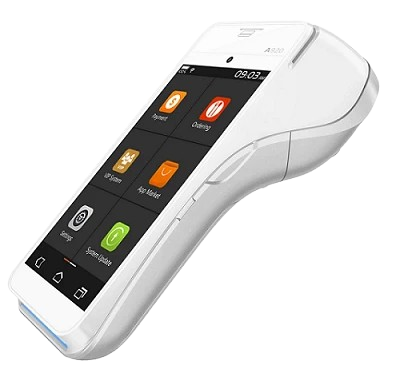
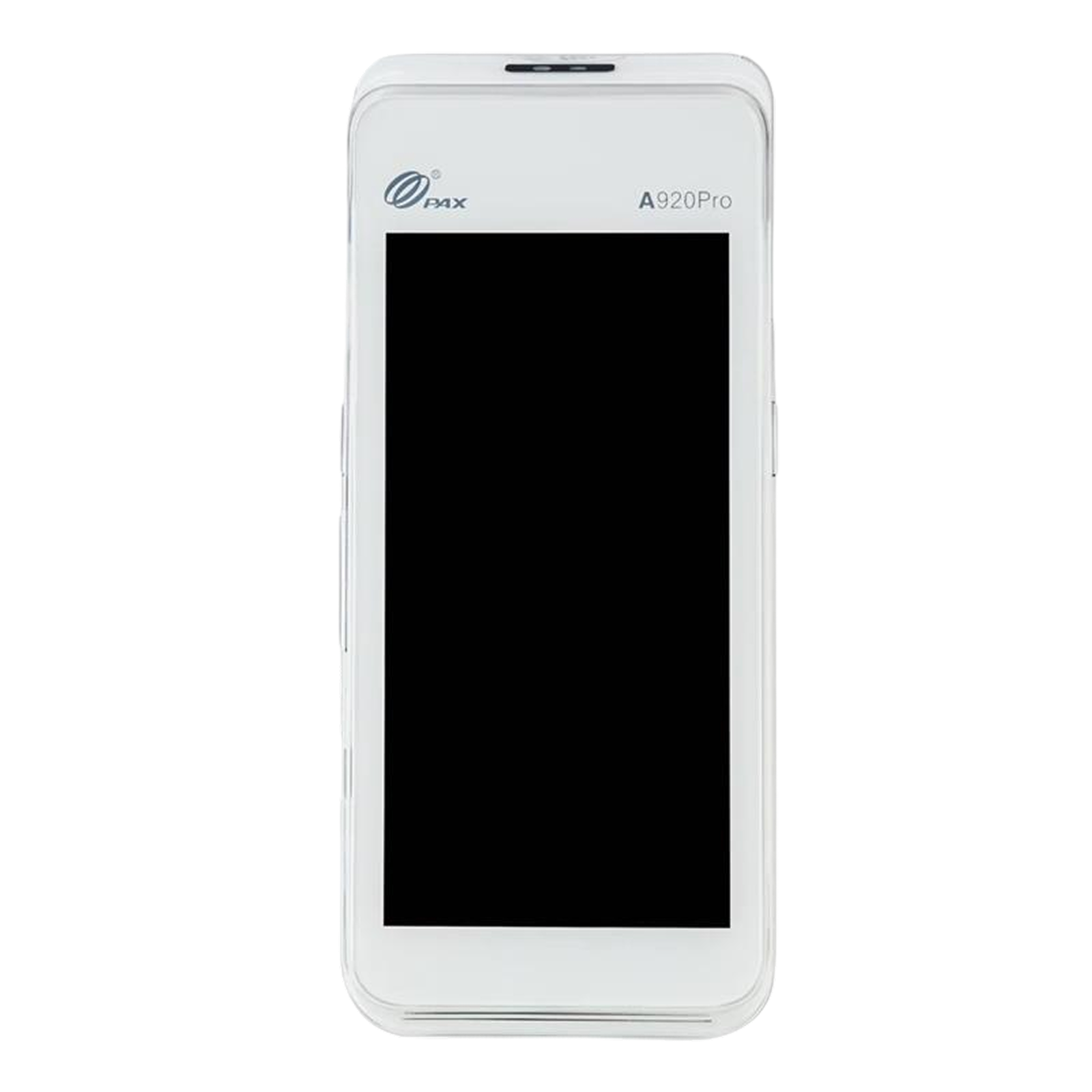
So Which One Fits Your Store?
Not every retail setup needs the same machine, and honestly, a lot of comparison articles skip over this part because "buy the newer one" is an easier sentence to write.
If you run a smaller shop — moderate foot traffic, not juggling five different apps at the till — the standard A920 Smart POS device is honestly enough. Spending extra for power you'll never use doesn't make a lot of sense.
If your store is busy non-stop — supermarkets, multi-counter setups, anywhere a slow checkout literally creates a queue out the door — that's where the Pro starts paying for itself. Speed and battery aren't nice extras there; they're basically operational requirements.
And if you're doing mobile or outdoor retail — markets, festivals, pop-up events — you'll probably want the Pro as your wireless card payment machine of choice, mainly because running out of charge halfway through a busy Saturday with no outlet in sight is a genuinely bad day.
Security-Wise, It Doesn't Matter Which You Pick
This part is equal across both devices. Whichever one you go with, you're getting the same EMV payment device standard, same encrypted PIN handling, same tokenized transaction security. Nobody's cutting corners on the cheaper model here, so don't let that sway the decision either way.
Both Handle Contactless Fine Too
Same story with NFC payment processing — both machines work as a proper contactless payment terminal, handling Apple Pay, Google Pay, and regular tap cards without issue. One thing worth checking, though: sometimes NFC ships switched off by default during onboarding, so confirm with your processor that it's actually enabled before you assume it's working.
My Honest Take
If your store gets busy enough that even a few seconds of lag, or a battery dying mid-shift, would genuinely cost you a sale, get the Pro. If your volume is moderate and steady, save the money and get the standard A920. It's really that simple once you take the marketing language out of it.
Some retailers I've talked to actually run both — Pro at the main counter, standard model as a backup or for staff handling returns on the side. Doesn't have to be all-or-nothing.
Wrapping Up
At the end of the day, this Android payment terminal comparison isn't really about one machine being objectively "better." Both are secure, both process payments reliably, and both run Android fine. The real question is whether your business's pace justifies paying extra for speed and battery life you might not even need. Think about a normal Saturday at your counter — how many transactions, how many apps running — and the answer usually shows up on its own.
Still unsure? Ask your processor if you can trial one for a week before buying. Seeing it work at your actual counter tells you more than any spec sheet ever will.