


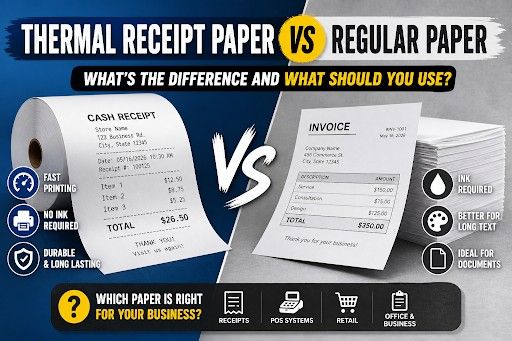
Thermal Receipt Paper vs Regular Paper: What's the Difference and What Should You Use?
High-quality peripherals paired with a suitable POS can significantly boost the overall efficiency of the operation. This is a secret, as many business owners understand very well. If you've ever run a retail counter, managed a food truck, or simply set up a point-of-sale system, you've probably thought about thermal receipt paper for POS.
After setting the POS, maybe you just grabbed whatever paper roll was in stock and shoved it in, thinking "that'll do it for now".
But here's the thing: the wrong paper roll doesn't give out the same results as specialized receipt paper. That also highlights the importance of choosing the right paper. If the wrong type is chosen, it can quietly cost you more money, cause headaches at the register, and even affect how professional your business looks to customers. So, let's actually talk about thermal vs regular paper for receipts, what's inside them, how they work, and which one makes sense depending on how your business operates.
Get Started With Us
Fill in your details and we'll get back to you shortly.
What Is Thermal Paper, Exactly?
Let's start with the basics. What is thermal paper? Unlike regular printer paper, thermal paper has a special chemical coating on one side, usually a mix of a dye and a developer layer. When heat touches that coating (from the print head in a thermal printer), it triggers a chemical reaction that turns specific spots dark. That's how the text and numbers appear: no ink, no toner, just heat.
This is why thermal printers are so popular at cash registers, retail counters, restaurants, and logistics companies. The setup is simpler, the printing is faster, and there are no ink cartridges to deal with. Once you understand how thermal receipt paper works, it's pretty hard to go back to managing ink supplies.
The Key Difference Between Thermal and Normal Paper
The difference between thermal and normal paper comes down to three things: how the image is created, what equipment you need, and how long the print lasts.
Regular paper, the kind in your office printer, is uncoated or lightly coated, and it needs ink or toner to produce text. A standard inkjet or laser printer pushes ink onto the paper fibers. Thermal paper skips all of that. The coating does the work when the print head applies heat. This is also why you can't just put a thermal paper roll into a regular inkjet printer and expect it to work; they're fundamentally different systems.
When people compare thermal paper vs plain paper printing, the most obvious difference is the equipment cost and ongoing supply cost. Thermal printers have fewer moving parts. There's no ink to run out. But the trade-off is paper cost; thermal rolls can be slightly more expensive per unit, and they're more sensitive to heat and light over time.
Perks of Using Thermal Paper for Your Business
There's a reason most modern POS setups default to thermal printing. The benefits of thermal paper are hard to ignore once you look at the full picture:
- Speed: Thermal printers are fast. A receipt prints in under two seconds in most cases, which matters when you have a line at checkout.
- No ink or toner costs: This alone is a significant saving for businesses that print thousands of receipts each month.
- Low maintenance: Fewer components in a thermal printer mean fewer things to go wrong. There's no printhead clogging, no cartridge replacements, no smeared ink.
- Compact design: Thermal printers tend to be smaller, which works well for countertop POS setups where space is tight.
For anyone choosing receipt paper for cash registers in a high-volume environment, thermal is almost always the better option. The upfront savings on ink and maintenance add up quickly. Pair rolls with the right POS peripherals for your lane.
Disadvantages of Thermal Paper Worth Knowing
Nothing's perfect, and thermal paper is no exception. The disadvantages of thermal paper are real, but they just don't outweigh the benefits in most business contexts.
So, what is the main issue here? Its durability.
Let's discuss this in depth. Thermal paper's durability and lifespan are limited compared to regular paper. The chemical coating is reactive, which is great for printing, but not great for storage. Direct sunlight, heat, and even some hand sanitizers or plasticizers can cause the print to fade or the paper to darken unevenly. If you're wondering, does thermal paper fade over time? Yes, it does, and fairly quickly in poor conditions. A receipt left in a hot car for a few hours can come out nearly blank.
For businesses that need long-term printed records, say, warranty receipts or legal documents, this is worth thinking about. In those cases, plain paper with ink printing holds up significantly better over the years of storage.
Complete Cost Comparison Between the Two
Let's talk money, because this is where the decision often gets made. When you compare the cost of regular paper vs receipt paper, the upfront numbers can be misleading.
Thermal receipt paper rolls are priced per roll and tend to cost slightly more per sheet than standard copy paper. But once you factor in ink and toner, which can run anywhere from $20 to $100+ per cartridge, depending on your printer, the real cost equation shifts. A business that prints 500+ receipts a week will almost always save money with thermal printing over 12 months, even if the paper itself costs a bit more.
The difference between coated and uncoated paper also plays into this. Thermal paper is a form of coated paper (the chemical coating is what enables heat-activated printing). Uncoated paper, like standard copy stock, doesn't respond to heat the same way; it's cheaper per ream, but it requires ink-based printing, which adds ongoing cost. For most point-of-sale operations, the coated thermal option wins on total cost of ownership.
Eco-Friendly Receipt Paper Options
Along with the question of safety, "Is thermal paper safe to use?", sustainability is increasingly on the radar for businesses of all sizes. The good news is that eco-friendly receipt paper options have expanded significantly in recent years.
Unlike the old times, the current receipt paper manufacturing channel doesn't include harmful substances like BPA formulation. Beyond BPA-free paper, now you can get your hands on many different paper options that are made from:
- Recycled materials
- FSC-certified paper
- Phenol-free thermal coatings
There is also a significant number of businesses that have made a conscious effort to simply not use traditional receipt paper and shifted to using digital receipts sent via email or SMS. This strategy helps the business owner to simply eliminate excessive paper use entirely for customers who prefer it.
That said, physical receipts are still necessary for many industries, and choosing which paper is better for printing receipts from an environmental standpoint really comes down to sourcing consciously and reducing waste where you can.
Learn more about sustainable paper manufacturing and its effect on sustainability via well-researched resources on paper's environmental footprint compared to digital alternatives on Two Sides North America.
3 Common Use Cases of Thermal Receipt Paper
As a business owner, you must have found yourself wondering about when to use thermal receipt paper in your specific situation. Here's how it plays out across a few common industries:
Retail
Almost every modern retail POS system is built around thermal printing. Speed at the counter, no ink refills, clean output, it's the obvious choice for any store doing consistent daily sales.
Restaurants and Cafes
Most kitchens traditionally use thermal ticket printers. The same goes for front-of-house receipt printers. The lack of ink is especially useful in kitchen environments where humidity and grease can cause problems with ink-based systems.
Logistics
Most businesses with high inventory levels tend to print labels, manifests, and packing slips using thermal printers. Why? Because they hold up well during transit. However, you should always keep them away from extreme heat. For short-term logistics documentation, thermal is excellent.
Understanding thermal paper uses in business across these sectors shows that the technology is versatile; the key is knowing where it fits and where it doesn't.
What's the Best Paper for Receipts Overall?
So, from now on, if someone asks you, "What is the best paper for receipts for a standard retail or food service business?" You can confidently answer, "It's thermal paper," like it's a no-brainer.
Why? It's faster. It's lower in maintenance. It's more cost-effective over time.
For businesses that need archival-quality records or can't invest in a thermal printer upfront, regular paper with ink printing is a reasonable choice.
The comparison between thermal printing and ink printing essentially comes down to your volume, storage needs, equipment, and budget. Most modern businesses that are starting fresh with a POS setup would be better served by going thermal from day one.
The Final Verdict!
After all this discussion, the final verdict is yours. What do you think about switching to reliable thermal printer paper?
Choosing between thermal and regular paper might seem like a small operational detail, but it touches everything: your printer costs, your customer experience, your environmental footprint, and how long your records actually hold up. The right choice solely depends on your specific setup, but for most business owners running a point-of-sale operation, thermal receipt paper is the clear frontrunner.
At Soireeinc, we help businesses think through decisions like this. If you're setting up or scaling a retail or hospitality operation and want guidance on building systems that actually work together, let's have a conversation. We're here to make sure every piece of your business infrastructure makes sense, not just the flashy parts. Contact our team.