


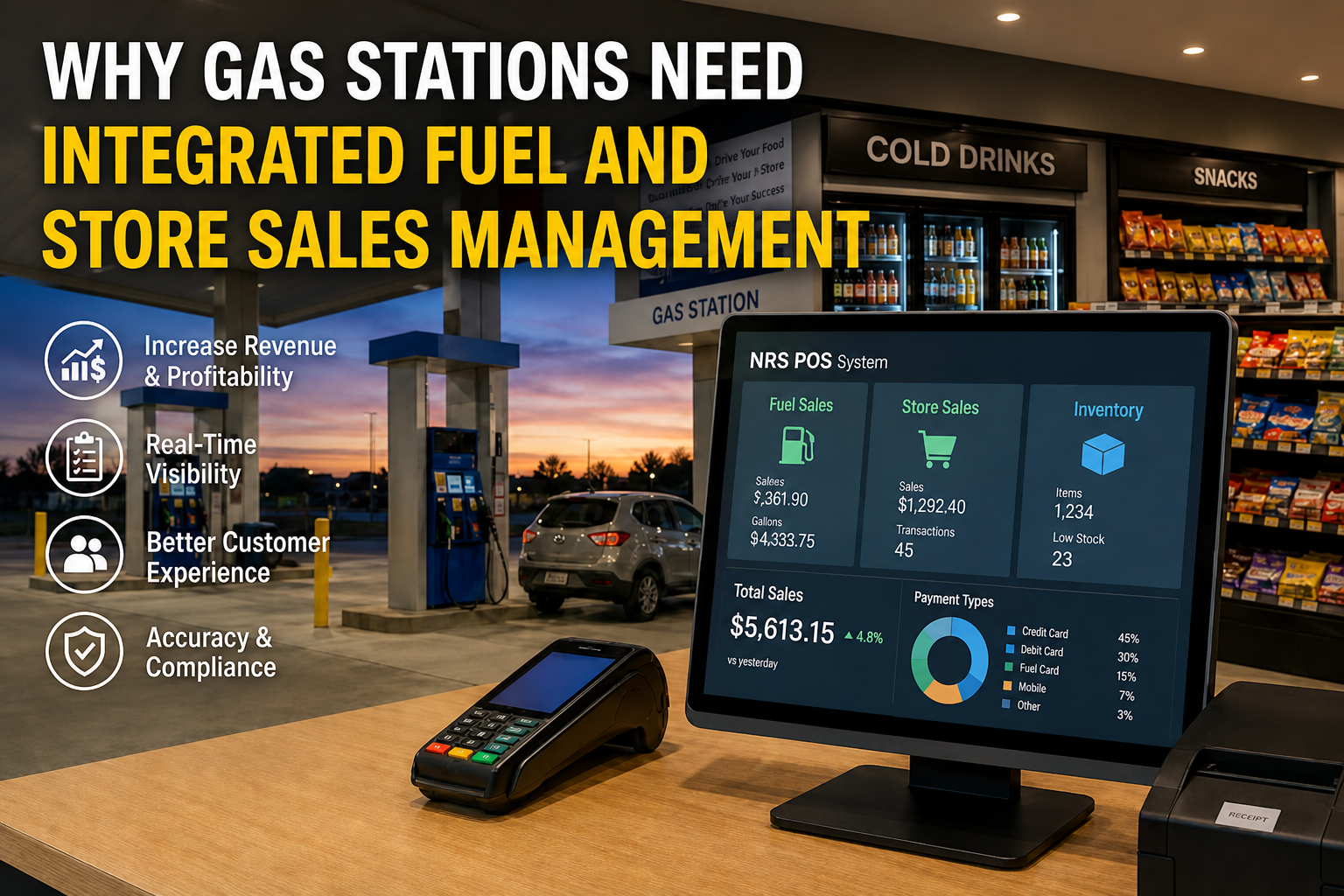
Why Gas Stations Need Integrated Fuel and Store Sales Management
Gas stations running fuel pumps and convenience stores as two separate systems are quietly losing money every day. The fix is simpler than most operators think: a single, unified point-of-sale solution that tracks fuel transactions and retail sales under one dashboard. The NRS POS System was built specifically for this problem — combining forecourt management, inventory tracking, and payment processing into one platform. If you're still reconciling paper fuel logs against your store register at the end of every shift, this guide explains exactly why that method is costing you and what an integrated system actually looks like in practice.
What Problems Does Splitting Fuel and Store Sales Actually Cause?
Most operators don't realize the damage until they look at their shrinkage numbers.
When fuel and store sales are tracked separately, your end-of-day reconciliation becomes guesswork. A pump transaction that's voided on one system doesn't automatically adjust in the other. Drive-offs get logged in the forecourt system but never reach your retail inventory report. And if you have multiple employees managing pumps and the register separately, accountability gaps appear fast.
The operational impact compounds over time. Fuel pricing errors made at the pump don't trigger alerts in the store system. Prepay fuel amounts that aren't fully used sit unclaimed because no one system tracks the discrepancy.
A gas station running two disconnected systems can misreport up to 3–5% of daily revenue without a single instance of intentional theft.
How Does the NRS POS System Handle Fuel Pump Integration?
This is where integrated management shifts from a concept to a real operational tool.
The NRS POS System connects directly to your forecourt controller, meaning every pump transaction — prepay, post-pay, fleet card, or drive-off — is recorded in the same system handling your store's retail sales. There's no manual transfer of fuel data. No end-of-night data entry. The pump authorization, fuel volume dispensed, and payment method all flow into one report automatically.
| Feature | Disconnected Setup | NRS POS Integrated Setup |
|---|---|---|
| Pump authorization | Separate forecourt terminal | Handled directly from POS |
| Drive-off tracking | Manual log or lost | Auto-flagged in system |
| Fuel + store report | Two separate files | Single unified dashboard |
| Fleet card processing | External terminal | Built into POS workflow |
| Price change updates | Manual per system | One-point update |
The real time-saving shows up at shift change. Instead of comparing two systems, your manager reviews one screen.
Fuel pump integration eliminates an average of 45–90 minutes of daily reconciliation work per station.
Why Is Inventory Management Different at a Gas Station vs. a Regular Store?
Convenience store inventory and gas station inventory don't follow the same rules — and most general retail systems ignore that completely.
At a gas station, your top-selling items are often impulse purchases tied directly to fuel visits. A customer comes in to prepay for gas and leaves with a drink, a snack, or cigarettes. That traffic pattern changes how you stock, price, and reorder. Your inventory system needs to track not just what sold, but when it sold relative to fuel traffic peaks.
Gas station inventory management also involves regulated products — tobacco, lottery, age-verified alcohol — that require specific tracking, reporting, and sometimes state-mandated audit trails. A convenience store POS system designed for gas stations handles these compliance requirements differently than a standard retail system does.
Beyond that, fuel itself is inventory. Tank levels, deliveries, variance reporting, and shrinkage all require tracking that has nothing to do with how a typical retail store manages stock.
Gas stations that track fuel and store inventory in the same system reduce shrinkage-related losses by an average of 18% in the first six months.
What Payment Types Should a Gas Station POS System Support?
The payment landscape at a gas station is more complex than almost any other retail environment.
You're handling standard credit and debit, EBT, fleet cards (WEX, Voyager, Comdata), proprietary loyalty cards, and mobile wallets, and sometimes prepaid fuel cards — often all in the same hour. A system that can't process fleet cards natively forces you to run a second terminal, which breaks your unified reporting immediately.
Gas station payment processing also needs to handle declined authorizations, partial-pay scenarios (a customer puts $20 on the pump but only takes $17.50 in fuel), and the hold-then-settle timing that fuel transactions require from card networks.
The NRS Petro POS is built with these payment flows in mind, handling fuel authorization holds differently from standard retail transactions and settling them correctly without manual intervention.
Incomplete payment handling is the single most common cause of end-of-day cash discrepancies at fuel retailers.
How Does Forecourt Management Connect to Store Sales in Real Time?
Forecourt management is the layer between your fuel pumps and your business data — and most operators never fully use it.
Real-time forecourt management means your store knows the moment a pump is activated, how much fuel is being dispensed, and when the transaction is complete. That data feeds your daily fuel report, variance calculations, and theft detection without any manual step.
When forecourt and store POS are integrated, you get cross-sale visibility. You can see that 68% of customers who prepaid for fuel also made an in-store purchase — and that data lets you make better decisions about store layout, promotions near the register, and which products to push during peak fuel hours.
Real-time integration also means your fuel pricing updates instantly across both the pump display and the POS receipt. Change your per-gallon price once, and it reflects everywhere simultaneously.
Gas stations with real-time forecourt-to-store integration report 22% fewer pricing discrepancy complaints per month.
Conclusion — What This Means for Your Station
Running fuel and store sales through two separate systems isn't just inefficient — it's a slow, invisible revenue leak. The FSII Framework (Fuel → Store → Inventory → Unified Reporting) gives you a clear way to evaluate whether your current setup is actually integrated or just connected on paper.
An integrated solution does three things at once: it eliminates reconciliation errors, it gives you real cross-sale visibility, and it handles the payment complexity that gas stations specifically face — from fleet cards to prepay overages — without manual workarounds.
The technology exists. The question is whether your current system is using it.
Get Started With Us
Fill in your details and we'll get back to you shortly.