


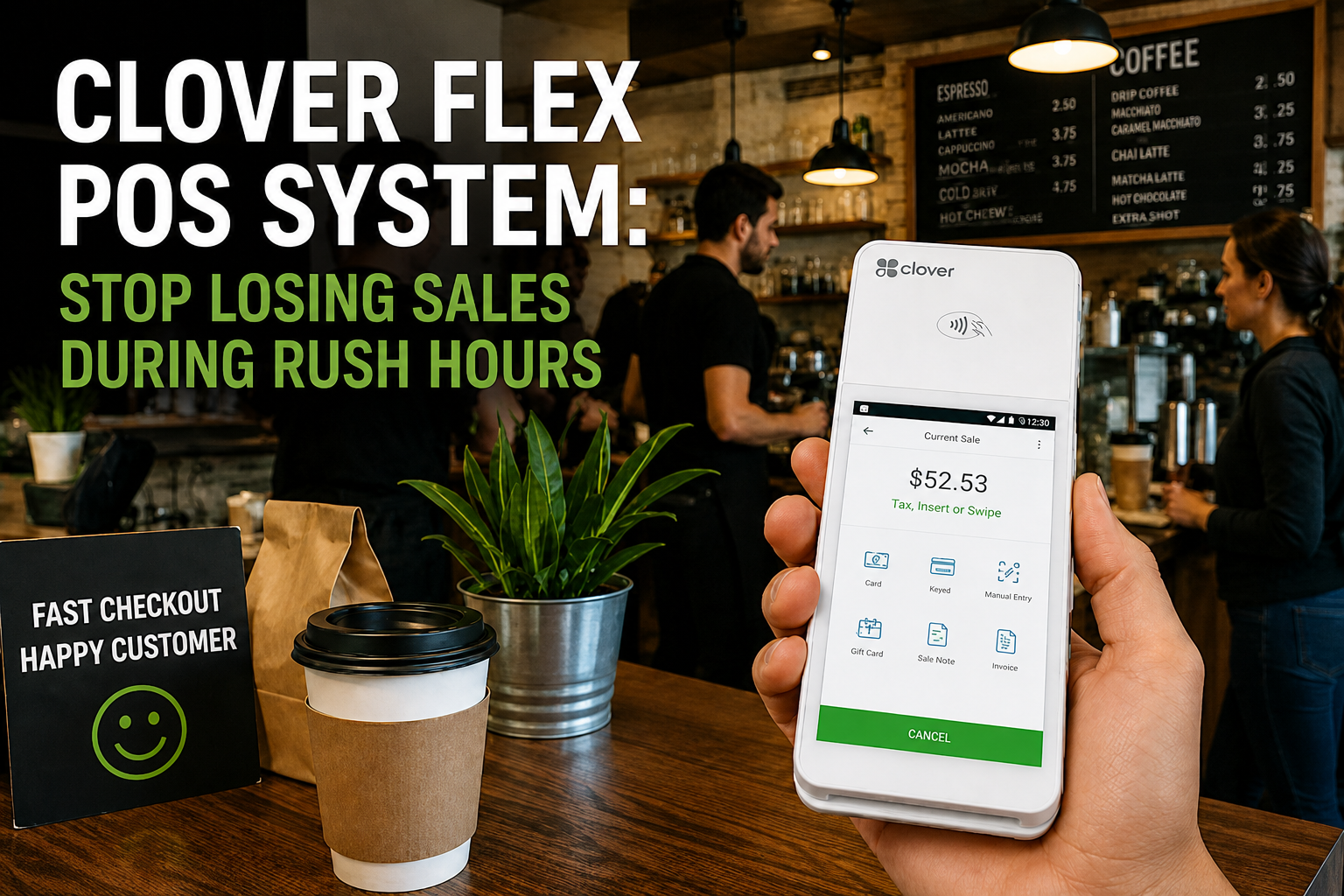
Clover Flex POS System: Stop Losing Sales During Rush Hours
The Real Problem With Rush Hours (It's Not Your Staff)
Here's something most business owners get wrong — they think rush hour chaos is a staffing issue. Hire one more person, problem solved. But watch what actually happens when a line builds up.
The staff is fine. The products are ready. Customers are standing there, money in hand. The breakdown is almost always happening at the single fixed terminal that everyone has to walk to, wait at, and process through one by one.
That's where the Clover Flex POS system changes things. It doesn't replace your counter — it removes the counter as the only payment option. Transactions happen where customers are standing, not where your wiring happens to be. Under 10 seconds per contactless payment. No separate printer to find. Done.
If customers are walking out before they pay, keep reading.
Why Customers Leave Before Paying — And What the Data Says
Three minutes. That's roughly the point where a waiting customer stops being patient and starts calculating whether it's worth it.
A study by Omnico Group found that many shoppers abandon purchases after excessive checkout delays, while long queues also reduce the likelihood they'll return.
The checkout delay problem usually comes from one of four places:
| The Bottleneck | Why It Happens | What It Costs You |
|---|---|---|
| One fixed terminal | Queue doesn't split — everyone waits in the same line | Lost sales during peak hours |
| Slow card processing | Older hardware or spotty connectivity adds 30–60 seconds per transaction | Irritated customers, shorter average ticket |
| Staff pulled away | One person covering floor and register at once | Longer waits, mistakes under pressure |
| No line-busting setup | No way to take payment before the counter | The entire queue moves at one speed |
None of this is fixed by rushing your team. The issue is physical — the payment point is in one place, and everyone has to reach it.
How Fast Does Clover Flex Actually Process Payments?
Genuinely fast. Contactless transactions — tap to done — average under 10 seconds. That includes the payment confirmation and receipt.
To put that in real numbers: say you run a coffee shop doing 90 orders in a 2-hour morning rush. If your current setup averages 35 seconds per checkout and Clover Flex brings it to 18 seconds, you've freed up nearly 25 minutes of processing time in a single shift. That's 8 to 10 extra customers served without adding a single staff member.
It accepts chip cards, magstripe, Apple Pay, Google Pay, Samsung Pay — all of it. No "sorry, we don't take contactless" moments. No asking customers to insert instead of tap. One device, every payment type, done.
The built-in printer matters too. Customers don't walk to a separate receipt station. The receipt comes out of the same device that just took the payment. Small thing, but it eliminates one more 15-second delay per transaction.
Can One Device Really Reduce the Checkout Line?
Yes — through something called line-busting, which big retailers have used for years but many small businesses still haven't implemented.
The idea is simple. Instead of waiting for customers to reach your terminal, a staff member walks into the line with a Clover Flex mobile POS and starts checking out customers before they reach the counter. By the time those customers get to the front, they're already paid. They just pick up their order and leave.
Here's how that actually works in a real setup:
- Line reaches 5+ people.
- A staff member steps into the queue with Clover Flex.
- Customers tap, insert, or swipe their card.
- Payment is completed in under 10 seconds, and the receipt prints immediately.
- Customers collect their order instead of waiting for the payment terminal.
- The staff member moves to the next customer still in line.
The wait doesn't get shorter, technically. But the payment part is finished early, so the remaining wait feels purposeful rather than pointless. That's the difference that helps keep customers from leaving.
Is It Reliable Enough for a Busy Saturday?
This is the question that actually matters. A device that works 90% of the time is useless during your busiest 10%.
Clover Flex runs on its own dedicated Android system — not a generic tablet with a payment app bolted on. That means it's not competing with background apps, browser tabs, or OS updates mid-shift. The battery lasts up to 8 hours under normal use, covering a full shift at most food, retail, and service businesses.
The offline mode is worth knowing about. If your internet drops — at an outdoor market, during a provider outage, or at an event venue with unreliable Wi-Fi — Clover Flex queues the transactions and syncs automatically when connectivity returns. You don't stop selling. You don't tell customers to find an ATM. You keep going.
One thing most reviews skip: the screen is daylight-readable. If you're at a farmers market in July or running a patio bar in the afternoon, this actually matters. A washed-out screen in direct sunlight slows everything down.
Which Businesses Actually See the Biggest Improvement?
Not every business has the same peak problem. But some business types feel the rush-hour squeeze harder than others.
Coffee Shops and Cafés — The margin on each transaction is small, so volume is everything. A 90-second checkout on a $4 order is a painful ratio. Faster checkout means more customers served per hour and better daily revenue.
Food Trucks and Pop-Ups — No fixed infrastructure, no reliable Wi-Fi, no countertop. Clover Flex is self-contained and works in conditions most POS setups can't handle.
Boutique Retail During Holidays — Small staff, high traffic, and customers who leave if they feel ignored. One person on the floor with Clover Flex can keep the queue moving without pulling shoppers to a checkout counter.
Salons and Service Businesses — Payment happens at the chair or workstation instead of a separate register. That removes the awkward "follow me to pay" step and keeps appointments running on time.
Farmers Markets and Events — Outdoor locations, high customer volume, and short selling windows make every minute valuable. A portable payment device helps process more sales before the crowd moves on.
The FLEX Checkout Method: A Framework That Actually Works
Here's a simple way to apply what Clover Flex makes possible. Call it the FLEX Checkout Method — four moves that change how your busiest hours run:
| Step | What You Do | Problem It Removes |
|---|---|---|
| F — Float | Staff steps into the queue with the device | Customers waiting passively with nothing happening |
| L — Limit friction | One device handles every payment type | "We don't take that" moments, extra hardware |
| E — Eliminate the bottleneck | Payment happens before customers reach the counter | Single terminal becoming the choke point |
| X — Exit clean | Receipt prints immediately on the device | That final 15-second wait at a separate printer |
Start applying this only during your two highest-volume hours. Once those run smoothly, everything else tends to follow.
Wrapping Up
Rush-hour revenue loss is a solvable problem — but only if you treat it as a payment flow issue, not a staffing one. The payment terminal is often the bottleneck. Moving payment capability off the counter, into the queue, and into your staff's hands is what actually changes the numbers.
The FLEX Checkout Method gives you a repeatable way to do that: float into the line, accept every payment type, remove the counter as the only payment point, and let customers leave faster.
Get Started With Us
Fill in your details and we'll get back to you shortly.