


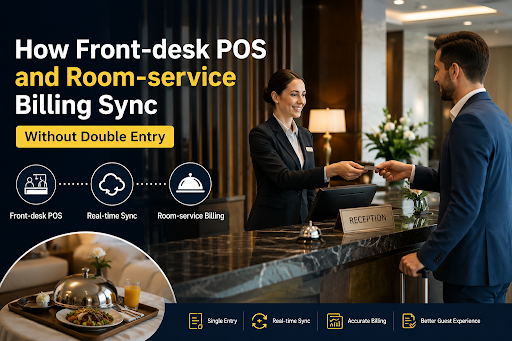
How Front-Desk POS and Room-Service Billing Sync Without Double Entry
Picture a busy evening at a travel plaza with attached lodging. A guest checks in at the front desk, orders food to their room an hour later, then grabs snacks from the convenience store before heading out at dawn. Three transactions. Three chances for something to go missing from the final bill — unless every system is talking to the same one.
That's the whole point of syncing your front desk POS system with room-service billing. And for operators running fuel, retail, and hospitality under one roof, the NRS Petro POS approach of running everything from a single platform is exactly the model worth understanding. Let's break down how it actually works.
Why Double Entry Is Quietly Draining Your Property
Double-entry sounds harmless. A staff member rings up a room-service order on one terminal, then walks over (or calls) to post the same charge on the guest folio at the front desk. What could go wrong?
Plenty, as it turns out.
Every manual re-entry is an opportunity for a typo, a missed charge, or a duplicate. Industry operators regularly report leakage — charges that never make it onto the folio — whenever billing depends on humans copying numbers between screens.A $14 sandwich here, a $9 late-night delivery there.Multiply that across a year, and you're looking at real money walking out the door.
Then there's the checkout problem. A guest is standing at the desk at 6 a.m., keys in hand, and the folio doesn't reflect the breakfast they ordered twenty minutes ago. Now the desk agent either delays the guest while chasing the kitchen ticket or lets the charge go. Neither option is good for revenue or reviews.
What "Sync" Actually Means: PMS and POS Integration Explained
At the heart of hotel billing automation sits one relationship: the connection between your hotel property management system (PMS) and your point of sale.
The PMS is the brain of the lodging side. It knows who's in which room, when they arrived, and what their folio looks like. The POS is the brain of everything sold — food, drinks, retail items, and fuel at a travel plaza. PMS and POS integration means the two share data in real time, so a charge rung up anywhere on the property lands on the correct guest folio automatically.
Here's the flow in plain terms:
- The guest identifies the room. The server or cashier enters the room number at the POS terminal.
- The POS pings the PMS. It verifies the guest name and confirms room-charge privileges are active.
- The charge posts instantly. The itemized order appears on the folio — item names, prices, tax, tip — with no one retyping anything.
- Checkout is clean. The front desk sees one complete, accurate bill, and the guest sees exactly what they spent.
No duplicate work. No sticky notes. No "let me call the kitchen and check."
Where the NRS Petro POS System Fits Into This Picture
Now, a fair question: what does a petro-focused POS have to do with room service?
More than you'd think. NRS Petro is built for gas stations, truck stops, and marinas — and a growing share of those businesses also operate lodging. Highway travel plazas with motel rooms. Marinas with overnight slips and guest suites. Truck stops offering driver accommodations. These hybrid properties face the exact double-entry nightmare hotels do, often multiplied, because they're juggling fuel sales, c-store retail, food service, and rooms all at once.
The core philosophy behind the NRS Petro POS system is consolidation: one platform running the whole operation instead of four vendors that don't speak to each other. NRS Petro connects the register directly to fuel dispensers, tracks in-store inventory, and manages every sales channel from a single touchscreen. For a hybrid operator, that same single-platform thinking is what eliminates double entry — whether the charge starts at the pump, the deli counter, or a guest's room.
If your property pairs fuel and retail with lodging, the practical move is to run your sales channels through a unified system like NRS Petro POS and connect your lodging software to it, so charges flow into guest folios instead of living on separate paper tickets.
Guest Folio Management: The Difference Guests Actually Feel
Guest folio management sounds like back-office jargon, but it's one of the few operational details a guest directly experiences. The folio is the story of their stay, written in line items.
When room service billing software feeds the folio automatically, three things improve overnight:
Accuracy. Every charge carries a timestamp, terminal ID, and itemized detail. Disputes drop because the paper trail answers questions before they're asked.
Speed. Checkout takes seconds. The folio is already complete, already correct, already ready to settle.
Trust. Guests who see a clean, itemized bill don't wonder what they're paying for. Surprise charges at checkout are one of the fastest ways to earn a bad review; automated posting all but eliminates them.
The Hidden Payoff: Reporting That Finally Tells the Truth
Here's the part operators tend to underestimate. When your front desk POS system and room-service billing share one data stream, your reports stop lying to you.
With disconnected systems, you're reconciling a fuel report against a food report against a rooms report — usually in a spreadsheet, usually late at night, usually with numbers that almost match. With an integrated setup, you see revenue by channel, shift, and category from a single source of truth. NRS Petro's model of shift reconciliation and consolidated end-of-day summaries applies the same logic: close the day once, with confidence, instead of hunting discrepancies across systems.
That's not just convenient. Clean data is how you spot theft, catch pricing errors, and figure out which revenue streams actually carry your margins.
Getting There: A Realistic Path Without Ripping Everything Out
You don't need a six-figure overhaul to kill double-entry. A sensible sequence looks like this:
- Audit your charge flow. Map every point where a staff member manually copies a transaction from one system to another. Each one is a leak.
- Consolidate the sales side first. Get all revenue channels — fuel, retail, food — onto one modern POS platform.
- Connect lodging next. Link your property management system so room charges post automatically, then test with real orders before going live.
- Train for exceptions, not routine. Once posting is automatic, staff training shifts to handling edge cases like split bills or declined room charges.
The Bottom Line
Double entry isn't a staffing problem or a training problem — it's an architecture problem. When the front desk and room service run on systems that don't communicate, humans become the integration layer, and humans make mistakes.
The fix is a unified platform where every charge, from the fuel pump to the room-service tray, flows into one accurate record. That's the operating model NRS Petro POS was built around for fuel and c-store businesses, and it's the same model hybrid lodging operators should demand from their entire tech stack. Fewer errors, faster checkouts, happier guests — and a bill that's right the first time.
Get Started With Us
Fill in your details and we'll get back to you shortly.