


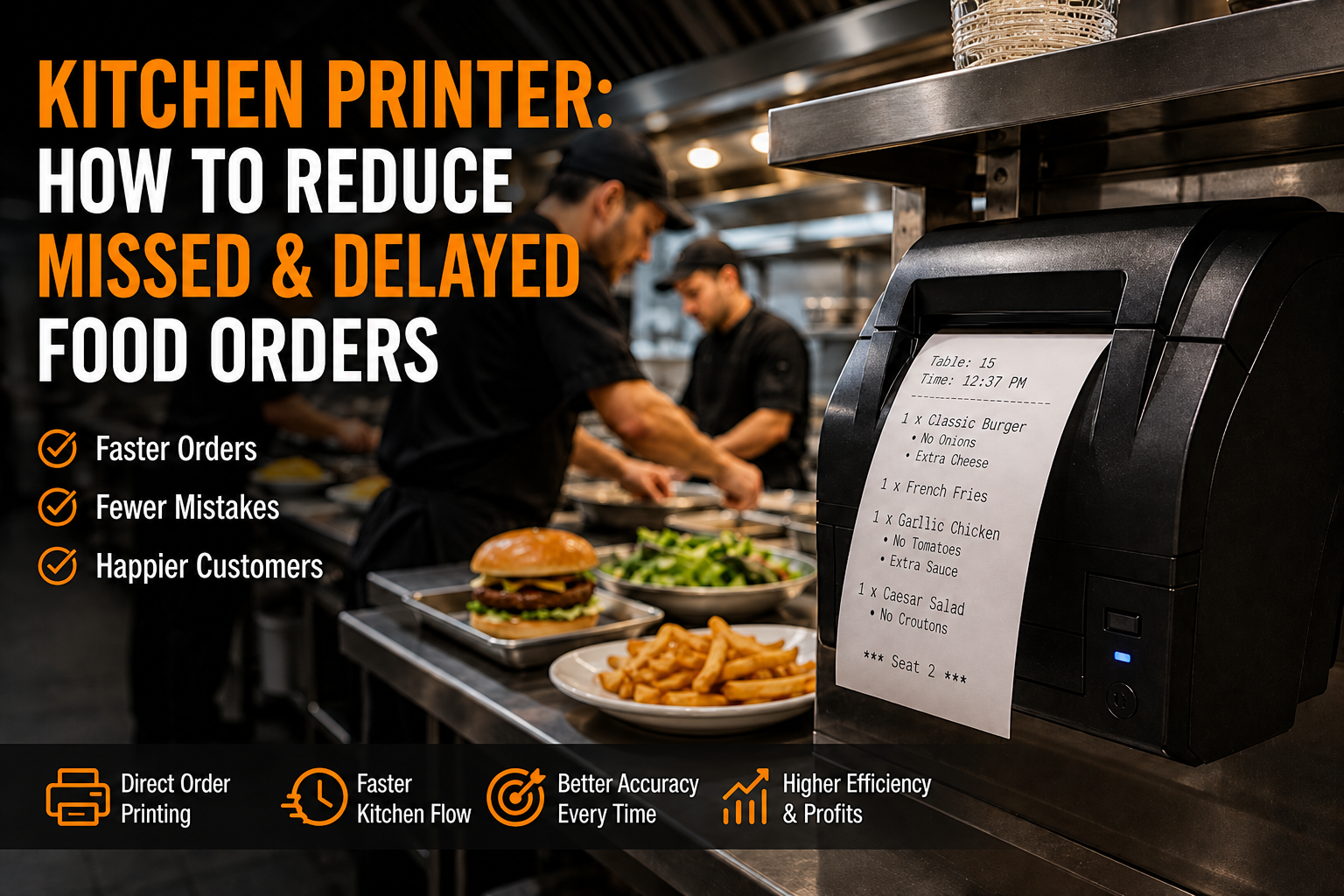
Kitchen Printer: How to Reduce Missed & Delayed Food Orders
What Every Restaurant Owner Needs to Know First
A kitchen printer is the single most underrated tool for cutting missed and delayed food orders in a busy restaurant. When verbal communication breaks down during rush hours, orders fall through the cracks — and your customer reviews pay the price.
Most guides tell you to "train your staff better." That's not wrong, but it's incomplete. The real fix is removing human memory from the order chain entirely. When every ticket prints automatically at the right station, your team stops guessing and starts executing.
This post breaks down exactly how a reliable kitchen printing system eliminates delays, what most restaurants get wrong, and a practical framework you can implement this week — even on a tight budget.
Why Do Food Orders Get Missed or Delayed in the First Place?
Order delays rarely happen because staff isn't trying. They happen because the communication system between front-of-house and kitchen is broken.
Here are the most common failure points:
| Root Cause | How It Happens | Impact |
|---|---|---|
| Verbal relay errors | Server shouts order across a noisy kitchen | Wrong dish prepared |
| Lost paper tickets | Handwritten slips fall or get moved | Order never made |
| POS not linked to kitchen | Order sits on screen, nobody acts | 10–20 minute delay |
| No station routing | One printer handles all tickets | Cook confusion |
| Rush hour pile-up | Multiple tickets arrive at once | Priority lost |
The hard truth: Restaurants using manual order communication experience up to 3× more order errors than those using an automated kitchen printing system — and most don't know it until they start tracking.
How Does a Kitchen Printer Actually Solve the Problem?
A kitchen printer receives order data directly from your POS system and prints a physical ticket at the right station — grill, prep, desserts, or bar — the moment an order is placed.
No shouting. No clipboard. No forgotten extras.
Here's what changes immediately:
- Speed — Ticket reaches the kitchen in under 5 seconds of order placement.
- Accuracy — Modifiers (no onions, extra cheese) print exactly as entered.
- Priority — Timestamps help cooks sequence orders correctly during rush.
- Accountability — Every ticket is a paper trail. Nothing disappears.
Restaurants that switch from verbal order relay to a kitchen printing system report a 40–60% drop in order remake costs within the first 30 days.
The printer doesn't replace your team — it removes the noise between them.
What Kind of Kitchen Printer Works Best for a Restaurant?
Not all kitchen printers are created equal. Choosing the wrong model causes more problems than it solves.
Here's a quick comparison of the main types:
| Type | Best For | Weakness |
|---|---|---|
| Thermal Receipt Printer | Small cafés, low volume | Fades in heat/humidity |
| Impact/Dot Matrix Printer | Hot, steamy kitchens | Slower, louder |
| Kitchen Display System (KDS) | High-volume, tech-forward restaurants | Higher upfront cost |
| Wireless Thermal Printer | Multi-station setups | Needs stable Wi-Fi |
For most independent restaurants, a wired thermal printer per station is the sweet spot — affordable, reliable, and fast. If your kitchen runs above 40°C regularly, choose an impact printer rated for heat exposure.
The biggest mistake restaurants make is buying one printer for the entire kitchen — creating a bottleneck that's worse than no printer at all.
How Should You Set Up a Kitchen Order Workflow That Prevents Delays?
Hardware alone won't fix your kitchen. The workflow around it matters just as much.
This is where the PRINT Framework comes in — a five-step system for building a delay-proof kitchen order flow.
P — Place printers at every cooking station, not just the pass. Each section (hot line, cold prep, grill, desserts) gets its own printer. Tickets go directly where the work happens.
R — Route orders by category in your POS. Burgers go to the grill printer. Salads go to the cold prep printer. Set this up once in your POS settings, and it runs automatically forever.
I — Include all modifiers and allergy notes on every ticket. Never let a modifier live only on a screen. If it's not printed, it will be missed.
N — Number every ticket with a table and time. Cooks need context. Table 12, 7:42 PM tells them urgency at a glance.
T — Train your team on ticket flow, not just cooking. Fifteen minutes of onboarding saves hours of confusion every week.
Restaurants using a structured station-based routing system with the PRINT Framework cut average ticket time by 4–7 minutes per order during peak hours.
Conclusion
Missed and delayed food orders are almost always a systems problem, not a people problem. When you put a kitchen printer at every station, route orders automatically, and follow the PRINT Framework, you remove the single biggest source of kitchen chaos — communication gaps.
Start small. Add one printer at your highest-volume station this week and track your order accuracy for 14 days. The data will tell you what to do next.
Get Started With Us
Fill in your details and we'll get back to you shortly.