


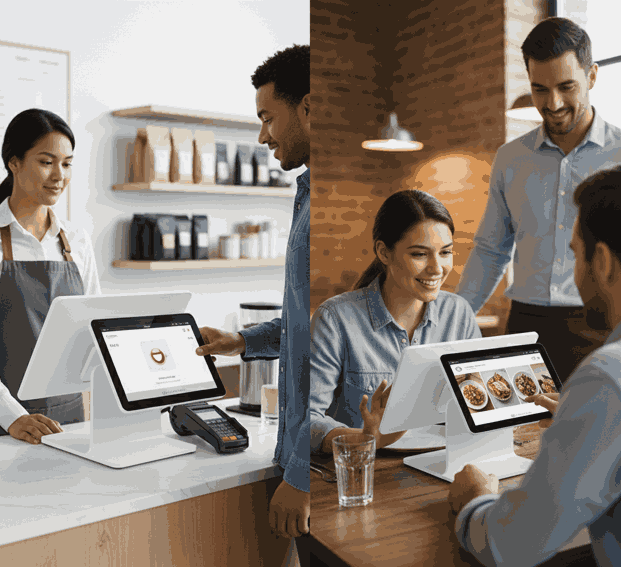
As a business owner, you need to make sure the system logistics are handled the right way to optimize daily operations. On one hand, a good POS can be a game-changer; a bad one can immensely impact productivity.
Retail stores and restaurants both have high processing costs and are busy year-round, selling, serving, and scaling. Even with similarities, the scale and product range differ significantly. Some POS may work for retail and be horrible at a restaurant. Therefore, it’s always advisable to perform a detailed comparison of POS devices across these two business types.
In this guide, we'll break down:
- How do these two needs differ?
- What features matter the most?
- How does technology support growth?
So, let's get you all the answers today!
Get Started With Us
Fill in your details and we'll get back to you shortly.
Understanding the Core Domain Difference
At a glance, both retail and restaurant POS appear to simply "swipe cards" and "print receipts". Without deeper insights, almost anyone can think both domains can work well with the same POS, only to later discover the mistake and realize they operate on different frequencies.
When it comes to retail, it mainly focuses on three main aspects:
- Speed At Checkout
- Product Tracking
- Flexible Pricing
Meanwhile, a Restaurant mainly cares more about:
- Order Flow
- Table Turns
- Kitchen Communication
That's where business owners need to understand that modern POS system machines must align with these realities to be useful in either domain.
Retail POS: Built for Fast Checkouts and Smarter Stock
Retailers need a POS that streamlines store management and eliminates errors. They want it to be an effective tool that keeps lines moving and their shelves stocked.
Key Retail POS system features are given below:
- Barcode Scanning
- Promotions
- Customer Profiles
Today, many store managers and owners use robust POS inventory management features to:
- Faster Payment
- Track SKUs in Real Time
- Avoid Overstocking
The question is: How can you find the Best POS software for your retail shop? Look for POS that support:
- Flexible Pricing
- Easy Returns
- Easy-To-Use, Detailed Analytics
- Clean Sales Reporting Pos
Restaurant POS for Optimal Sales and Service
Restaurants want one thing, and what is that: Fast efficiency. Unlike retail, restaurants have peak hours that result in a surge of orders that must be processed quickly and accurately. That's where the Restaurant POS system offers many advantages that a normal POS just can't.
So, what makes a POS be considered a solid Restaurant order management POS?
The answer is quite simple: it's a POS that offers:
- Smooth Order Movement
- Better Operational Flow
- Reduces Mistakes
- Decreases Wait Times
If you own a sit-down venue, then a restaurant table management POS is the best solution for you:
- Manages The Staff
- Balances Covers
- Maximize Seating Without Chaos
If you're researching the Best POS software for restaurants, you must prioritize systems that can handle:
- Modifiers
- Split Bills
- Real-Time Updating
Your team will thank you during the next rush hour.
Hardware Matters More Than Anything
Software is often given the most importance, as it is the foundation on which the entire logistics plan operates. But in real time, hardware holds the exact same value, even more in some cases, to meet daily touchpoints.
Many businesses now prefer Touchscreen POS devices compared to traditional POS devices. Why? They are quick and intuitive. In addition, they are easy to train. They can be a great tool for your business if you plan to open a pop-up or offer on-the-go sales. Mobile POS solutions give flexibility without sacrificing functionality.
So, next time when you sit down to choose a POS, go for the POS that offers reliable payment processing devices and contactless payment POS options. This way, you'll effectively boost customer trust and speed up transactions.
For restaurant and retail owners with tight budgets, this POS hardware for small businesses strikes a balance between durability and affordability.
Cloud, Integrations, and Scaling Up
Today's POS systems are not limited to counters only; they can be anywhere you want them to.
Nowadays, most businesses opt for Cloud-based POS systems to effectively manage them remotely.
But, how does that work? The new POS syncs data across locations.
Specifically, in a competitive environment, you must use a modern Multi-location POS system to stay ahead with consistent, centralized control.
Furthermore, other smart owners value POS system integration with apps such as:
- Accounting
- Loyalty
- Delivery Platforms
These connections reduce manual work and future-proof operations as requirements scale up.
Retail vs Restaurant: Side-by-Side Comparison
A quick POS terminal comparison is exactly what you need to do to locate what POS works for you.
Operational Difference
For retail businesses, a POS that optimizes checkout flow and product data. On the other hand, restaurants prioritize order timing and service coordination.
Domain Difference
Even the POS system for fast-food vs retail stores differs significantly under the label of domain needs. Restaurants like fast food require speed and menu simplicity, while retail needs flexibility.
On the cost side, the Cost of POS systems varies based on features, hardware, and scale. Investing a bit more upfront often saves money over the long term through greater efficiency and fewer errors.
Why the Right Partner Makes the Difference?
Technology without any kind of hardware support basically cannot implement the critical tasks of an effective POS. The main ingredient here is the optimal implementation of the device. Businesses that understand the importance of implementation tend to always go for POS brands that focus on offering POS solutions with:
- Faster Onboarding
- Smarter Customization
- Scalable Friendly
Only a POS retailer with the combination of these three can help you locate the best POS for your business. Brands like Soireeinc do more than just POS, supplying you with the right kind of POS system machinery and software.
Conclusion: Choose What Fits Your Work
At the end, the main thing is how the system fits into your already existing logistics. No matter whether it's retail or restaurant businesses, you need to find one that matches the customer flow, demand, and basic necessities of your business.
The right POS setup will:
- Support Your Staff
- Delights Your Customers
- Help You Scale Faster
The other main thing to notice is the current scale of your business operations. Suppose you are a small-scale business with not much Production line complexity. Go for a simpler POS that offers basic necessities rather than going for a full-fledged POS, as it will just slow you down with complex features that you didn't even need in the first place.
Ready to find a perfect POS solution that actually fits your business operations? Talk to our expert, and we'll hook up with the best POS systems in the market!