


Dual Pricing for Nail Salons: Is It Legal and Is It Worth It?
Every month, a slice of your service revenue goes to card processing fees. On a $60 full set, that's roughly $1.50 to $2 gone before your technician even gets paid.
Dual pricing is how a lot of salon owners are taking that money back. Your nail salon POS shows two prices for every service, one for cash and one for card, and the client picks.
So is it legal? Yes, in all 50 states, as long as it's set up correctly. Is it worth it? For most salons, yes. But set up correctly is where many owners get burned, so let's walk through it properly.
What Is Dual Pricing in a Nail Salon?
Dual pricing means every service on your menu has two listed prices. The card priceincludes your processing cost. The cash price is a little lower.
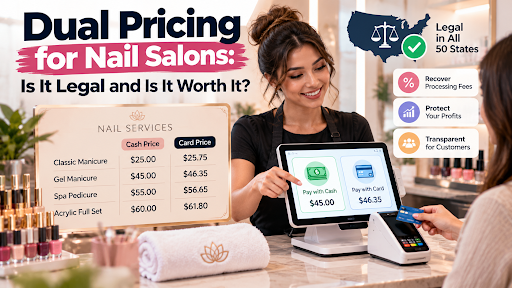
Here's what it looks like on a real service menu:
| Service | Cash Price | Card Price |
|---|---|---|
| Classic Manicure | $25.00 | $25.75 |
| Gel Manicure | $45.00 | $46.35 |
| Spa Pedicure | $55.00 | $56.65 |
| Acrylic Full Set | $60.00 | $61.80 |
The client sees both numbers before they sit down. Nobody is surprised at checkout, and that one detail is what keeps dual pricing legal.
Think of it like a gas station. You've seen the cash and credit prices posted side by side on the sign for years. Dual pricing brings the same idea to your front desk.
Dual Pricing vs. Surcharging vs. Cash Discount
These three terms get mixed up constantly, even by sales reps. They are not the same thing, and the law treats them differently.
- Surcharge: Your listed price is the cash price, and you add a fee when someone pays by card.
- Cash discount: Your listed price is the card price, and cash payers get a discount off it.
- Dual pricing: Both prices are posted side by side, so the client sees the full picture upfront.
Dual pricing is legally a form of cash discounting. That's why it works in states where surcharging is banned.
What Problems Push Nail Salons Toward Dual Pricing?
Most salon owners don't look into dual pricing because they want to. They look into it because the numbers stopped working.
Processing Fees Eat Into Thin Margins
Nail salons run on tight margins. Between product costs, rent, and technician commissions, a 2.5% to 3.5% card fee on every ticket adds up faster than most owners expect.
Card Tips Make the Problem Bigger
When a client adds a $10 tip on a card, you pay processing on that tip too. Many salons quietly absorb this cost, and some technicians end up pushing clients toward cash tips just to protect payouts.
Raising Prices for Everyone Feels Unfair
You could raise all your prices by 3% to cover fees. But then your cash clients are paying for a cost they never created, and that rarely sits well with regulars.
Bad Zero Fee Programs Create New Risks
Some processors sell zero fee programs that add a non-cash adjustment line at checkout. That's a surcharge wearing a disguise, and it can put your salon on the wrong side ofstate law and card brand rules.
Is Dual Pricing Legal for Nail Salons?
Yes. Dual pricing and true cash discounting are legal in all 50 states. Federal law protects a merchant's right to offer a discount for cash, and card networks cannot block it.
Surcharging is a different story. As of 2026, Connecticut, Maine, and Massachusetts (plus Puerto Rico) ban credit card surcharges outright. Even in those states, a properly builtdual pricing program is still allowed.
Connecticut's Department of Consumer Protection actually spells this out. Its official surcharge guidance says businesses can comply by listing a cash price and a credit card price, and it calls out non-cash adjustment fees at checkout as illegal surcharges.
The Card Brand Rules You Can't Ignore
State law is only half the picture. Visa's merchant rules decide whether your program counts as a discount or a surcharge, and Visa has stepped up enforcement in 2026.
To stay on the safe side, your program needs to:
- Post the card price as your regular price, not the cash price
- Show both prices before the service starts, on your menu and signage
- Avoid adding a separate "fee" line on the card receipt
- Print both prices clearly on every receipt
If your salon surcharges instead, Visa caps it at 3% and requires notice to your processor first. Colorado sets an even lower cap at 2%.
A Quick State-by-State Reality Check
| Your State | Surcharging | Dual Pricing |
|---|---|---|
| Connecticut, Maine, Massachusetts | Banned | Allowed |
| Colorado | Allowed, capped at 2% | Allowed |
| Most other states | Allowed with disclosure | Allowed |
Laws do change, so check your own state before you launch. The NFIB's surcharge and cash discount guide and the NCSL's state statute tracker are both good starting points. This isn't legal advice, so a quick call with your accountant or attorney is worth it.
Is Dual Pricing Worth It for Your Salon?
Let's run the numbers on a mid-size salon.
Say your salon runs $40,000 a month in card payments. At a 2.9% effective processing rate, you're paying about $1,160 a month. That's nearly $14,000 a year.
With dual pricing, most of that cost moves into the card price your clients choose to pay. For many salons, that's enough to cover a part-time technician's wages or a full equipment upgrade.
When It Works Best
- Salons with a mix of cash and card clients
- Walk-in heavy salons where price-conscious clients appreciate a cash option
- Owners who feel processing fees are cutting into technician payouts
When You Should Think Twice
- Luxury studios where clients expect a single, all-inclusive price
- Salons where nearly every client pays by card and none will switch
- Owners who aren't ready to update signage, menus, and staff scripts properly
Here's an honest truth. Most clients won't switch to cash. Dual pricing doesn't save you money by changing behavior. It saves you money because card payerscover the cost of the convenience they're choosing.
How Clients Actually React
In our experience, most clients barely notice once the menu shows both prices clearly. The complaints come when the extra charge appears for the first time at checkout. Clear signage solves almost all of it.
How to Set Up Dual Pricing on a Nail Salon POS
A clean setup protects you from fines and awkward front desk moments. Here's the process we recommend.
Step 1: Confirm Your State Rules
Check whether you're in a surcharge-ban state. If you are, dual pricing is your only compliant option for passing on card costs.
Step 2: Set Your Card Price as the Regular Price
Your menu's main price should be the card price. The cash price is the discount. Getting this backward is the most common compliance mistake.
Step 3: Update Your Menu and Signage
Post both prices on your service menu, your website, and your booking page. Add a clear sign at the entrance and at the front desk.
Step 4: Configure Your POS
Your nail salon POS should calculate both prices automatically, show them on the customer screen, and print them on every receipt. Manual math at the desk invites mistakes.
Step 5: Decide How Tips Are Handled
Decide whether tip suggestions calculate on the cash price or the card price, and keep it consistent. Your technicians should know exactly how their tips are calculated and paid out. If commissions are part of that payout, it helps to track staff commissions the same way on every ticket.
Step 6: Train Your Front Desk
Give your team a simple line to use: "Our menu shows a cash price and a card price. You're welcome to pay either way." Short, friendly, and no apology needed.
Step 7: Review After 60 Days
Look at your processing statements, client feedback, and cash-to-card ratio. Adjust your signage or scripts if anything feels off.
What Does a Nail Salon POS With Dual Pricing Cost?
Your total cost usually comes from three places: hardware, software, and payment processing.
| Cost Area | What Drives the Price |
|---|---|
| Hardware | Number of terminals, handhelds, printers, and cash drawers |
| Software | Booking, staff scheduling, commission reports, and dual pricing apps |
| Processing | Your card mix, average ticket size, and monthly volume |
Hardware is usually a one-time cost. Software is typically monthly. Processing is where dual pricing makes the biggest difference, because it shifts most of that cost off your books.
That's why merchant processing deserves as much attention as the device itself. The same Clover hardware can cost very different amounts depending on who sets up your rates and how well your dual pricing is configured.
Before you sign with any provider, ask for one number: your total monthly cost, including hardware, software, and processing. If they can't give you that clearly, keep shopping.
Ready to Cut Your Card Fees the Right Way?
Dual pricing can save your salon thousands every year, but only when the setup is compliant from day one. A rushed program with the wrong receipts or signage can cost more in fines than it saves in fees.
Soireeinc sets up Clover systems for nail salons with your service menu, technician profiles, tip rules, and a compliant dual pricing program already in place. Talk to our team for a custom quote based on your stations, staff, and card volume.
Get Started With Us
Fill in your details and we'll get back to you shortly.